
We Innovate to Deliver More Value
At Borges BAIN, we understand innovation as a key tool to keep growing and adapting to the demands of the agri-food market. That’s why we constantly invest in Research and Development, applying technological improvements to our processes and products.
Our R&D team works to optimize the quality, sustainability, and functionality of our solutions, collaborating closely with clients, suppliers, and technology centers.
The Value of R&D at Every Stage of the Process
We firmly believe that anticipating is the best way to lead the future. For this reason, we make significant investment efforts in researching, innovating, and improving processes, thus ensuring the company’s competitiveness and future.
The main ongoing projects are aimed at achieving:
- Improvements in drying/dehydration processes
- Improvements in steam production processes
- Valorization of by-products
- Development of new industrial packaging
Electric vehicle - MOVES III Program
BORGES AGRICULTURAL & INDUSTRIAL NUTS, S.A.U. has received a grant of €2,200 for the purchase of an electric vehicle under the Recovery, Transformation, and Resilience Plan, financed by the European Union. – NextGenerationEU, within the framework of the MOVES III Program managed by the Ministry for Ecological Transition and Demographic Challenge through the IDAE.
The GO ALERTFLORS Project
The GO ALERTFLORS project aims to develop an alert system to improve sustainable control of Monilinia laxa in almond trees.
Crisol de Frutos Secos SAT, together with Almendras Vicens SL, Ocean Almond SL, Borges Agricultural & Industrial Nuts SA, and Frutos Secos de las Garrigues SCCL, with the participation of the Institute of Agri-Food Research and Technology (IRTA), are working in the Operational Group under the acronym ALERTFLORS.
In recent years, almond cultivation has experienced significant growth worldwide and in Spain. New varieties with better agronomic performance have been introduced, and new, more intensive production models have been incorporated.
These changes in cultivation have led to pressure from new diseases as well as others previously thought to be controlled, such as moniliosis caused by Monilinia laxa, which is currently causing concern in the sector due to loss of competitiveness in a booming market. Therefore, it is essential to improve knowledge of these diseases, understand their life cycle, identify environmental and varietal factors that influence their incidence and severity, in order to implement sustainable strategies that improve management and mitigate losses.
The general objective of ALERTFLORS is to design and study the technical effectiveness of an alert system that indicates when there is a risk of infection by Monilinia laxa in almond crops. The aim is to determine the optimal and most effective timing for fungicide application and to achieve disease management that is sustainable both environmentally and economically for farmers.



The GO PROVEG Project
The GO PROVEG project aims to identify new sources of plant protein, characterizing their technological behavior for the development of new plant-based foods.
The technical objectives of the project are:
• Identify new sources of plant protein from mushrooms, nuts, and algae, among other co-products derived from food industry processes.
• Characterize the nutritional composition and technological behavior of these new plant protein sources.
• Develop different prototypes using plant protein ingredients studied within the project framework.
Participants: Embotits Salgot SA, Betara SL, La Fageda Foundation, Borges Agricultural & Industrial Nuts SAU, Eurecat Technology Center, INNOVACC.
Funded by:
Project funded through Operation 16.01.01 (Cooperation for Innovation) of the Rural Development Program of Catalonia 2014-2022


Energy Consumption Reduction at Borges 2
BORGES AGRICULTURAL & INDUSTRIAL NUTS, S.A. has received a grant of €86,102.06 for its energy-saving and efficiency project “Reduction of Energy Consumption at BORGES 2,” managed by the INSTITUTE FOR DIVERSIFICATION AND ENERGY SAVING (IDAE), co-financed by the European Union through the FEDER Operational Program for Sustainable Growth 2014-2020.
The project consists of two distinct actions:
• The first involves replacing an almond dryer without air recirculation with a much more efficient one with air recirculation.
• The second involves replacing a fixed-speed air compressor with a variable-speed, high-efficiency compressor, as well as adding an air dryer and an advanced control system that provide additional efficiency.
An estimated energy saving of 74.05 toe/year has been achieved.
GO Project: Detection and Eradication of Bitter Almond
Main Objective:
Sectoral project to develop systems that can be used at agronomic, production, and industrial scale to detect and eliminate bitter almonds.
Specific Objective 1:
Agronomic field evaluation of bitter trees and their geolocation for possible removal. Confirmation using Near Infrared Spectroscopy (NIRS) technology and innovative hydrocyanic detection kits.
Specific Objective 2:
Development of discriminant models with laboratory NIRS instruments to separate bitter almonds from sweet ones by batches upon reception at almond cooperatives.
Specific Objective 3:
Validation of prototypes with NIRS technology to detect and eliminate bitter almonds individually, grain by grain (“one by one”), from sweet almond lots on the production line.
This project to eradicate bitter almonds has an execution budget of €573,999 and is part of the aid for Operational Groups of the European Innovation Partnership (EIP), whose goal is to increase agricultural productivity and sustainability through the National Rural Development Program (NRDP) 2014-2020, under its 2018 call.
The work is funded 80% by the European Agricultural Fund for Rural Development (EAFRD) and 20% by the Ministry of Agriculture, Fisheries and Food, through Royal Decree 169/2018 of March 23.
The body responsible for the content of this project is the Operational Group: Detection and Eradication of Bitter Almond, with the Directorate General for Rural Development, Innovation and Forestry Policy as the authority in charge of managing the application of EAFRD and corresponding national aid.
For more information:
http://ec.europa.eu/agriculture/index_es
Website: www.sinalmendraamarga.es
Actions:
The most important actions planned for each point are:
Field Level:
Geolocation of most candidate trees with bitter almonds in commercial farms. Once these trees are marked and identified for having different agronomic behavior, various rapid analysis tests will be carried out using hydrocyanic detection kits and portable NIR technology (set up during the first year) to verify and confirm the presence of bitter almonds in these trees.
Reception Centers:
Work will focus on two levels:
- Use of laboratory analytical technology to detect hydrocyanic acid from the degradation of amygdalin present in bitter almonds using innovative detection kits.
- Batch discrimination using NIR technology at almond reception in cooperatives. A discriminant model will be developed to separate sweet and bitter almonds.
Processing Line:
Calibration and validation of an online hyperspectral NIR prototype to eliminate bitter almonds one by one with amygdalin presence.
Several milestones are expected to be achieved to eliminate bitter almonds from our fields, such as GPS geolocation of trees, action protocols with hydrocyanic kits, NIR discrimination models in the field (leaf and fruit) and at reception in the cooperative, and finally validation of hyperspectral NIR prototypes that allow identification and removal of bitter almonds on the processing line “online,” one by one, validating each action at all times.
Expected Results:
The potential impacts and focus areas that this GO “Detection and Eradication of Bitter Almond,” led by ALMENDRAVE, aims to consolidate are to meet the general objectives of EIP-Agri and work on Focus Areas 2A and 3A.
The ultimate impact on the sector is to increase the added value of the national almond sector (from producer to consumer), offering throughout the value and distribution chain a product of the highest possible quality, enabling Spanish almonds to compete with almonds produced elsewhere in the world.
The formation and implementation of this GO will impact all stages from the farmer to the final consumer, including cooperatives, shelling plants, processing industries (peeling and blanching), industries using almonds as raw material (such as nougat makers, chocolate manufacturers, snack industry in retail), and distribution industries (markets, supermarkets, and large retailers).
Sustainability Dimensions:
- Economic Sustainability:
The GO is designed from the outset to meet Focus Areas 2A and 3A, improving farm economic results and competitiveness of potential users of this innovation. Eliminating bitter almonds from our fields increases quality across the entire agri-food chain, from farmer to consumer, including producer organizations, cooperatives, industry, and interprofessional organizations. - Environmental Sustainability:
Environmental sustainability is reflected in the fact that at all three levels (field, cooperative reception, and production line), work will be carried out sustainably without polluting the environment. The proposed technology does not use hazardous chemicals nor generate toxic waste. Many GO members have Environmental Management Systems (ISO-14001), implementing an integrated environmental protection plan. - Social Sustainability:
The GO, as a multidisciplinary association of many actors across the value chain, will bridge the gap between scientific and research offerings (with IRTA as a reference) and the real needs of the primary agricultural and agri-food sector, represented by Producer Organizations, Agri-food Cooperatives, and private companies. Additionally, this GO aims to promote digitalization and Big Data (using cutting-edge technologies such as Near Infrared Spectroscopy (NIRS)), crucial today for stabilizing rural populations and fostering rural development
Project to Improve Efficiency of Refrigeration and Air Conditioning Installations
Main Objective:
Improve energy efficiency of technology in equipment and processes related to air conditioning and industrial refrigeration.
Investment Made: €246,228
Location:
Production center located at C/ Flix nº29, Reus
Aid obtained:
€52,514.99 through the Energy Saving and Efficiency Aid Line for SMEs and Large Companies in the Industrial Sector, co-financed by the European Regional Development Fund (ERDF) and managed by IDAE under the National Energy Efficiency Fund.

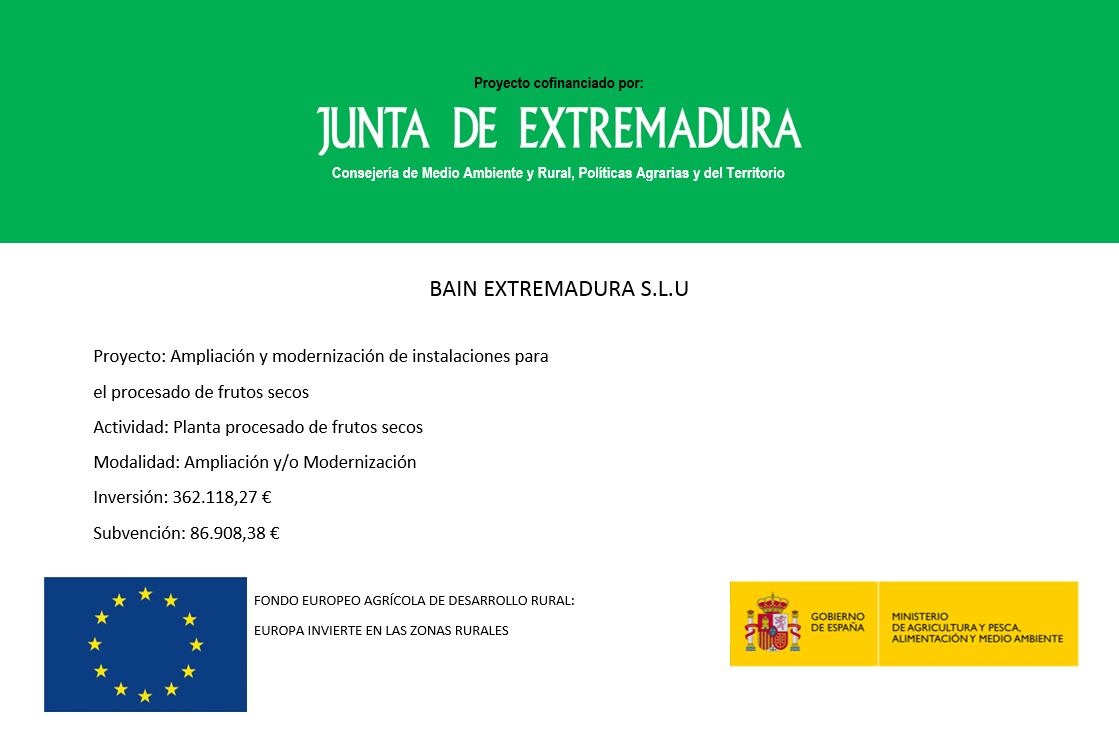
Project for Expansion and Modernization of Facilities for Nut Processing
Main Objective:
Expansion and modernization of facilities for nut processing
Investment made:
€362,118.27
Location:
Production center located at Crta. Olivenza, Badajoz
Aid obtained:
€86,908.38 under the provisions of Decree 306/2015 of December 4, which establishes the Agro-industrial Incentive Scheme within the Autonomous Community of Extremadura, related to rural development aid through the European Agricultural Fund for Rural Development (EAFRD).
Project for the Design and Development of a New Innovative Almond Paste Production Line at Borges 2 Facilities
BORGES AGRICULTURAL AND INDUSTRIAL NUTS, S.A. has carried out the “Project for the design and development of a new innovative almond paste production line at Borges 2 facilities” in the municipality of Reus, file number 93800042017.
This project was made possible thanks to aid framed under Priorities 3.A) and 5) of Measure 04 corresponding to “Investments in physical assets,” and Operations 04.02.01 and 04.02.02 of the “Catalonia Rural Development Program for the 2014-2020 programming period,” for an amount of €469,890.31, receiving a grant of €46,989.03 co-financed as follows: 57% charged to item AG06 D/77000400/6130/0000 of the DARP budgets and 43% charged to EAFRD.


Project funded through Operation 16.01.01 (Cooperation for Innovation) of the Catalonia Rural Development Program 2014-2020
Operational Group ALMON: Keys to Improving Moniliosis Management in Almond Trees
The Operational Group ALMON (GO) is formed by the consortium of companies CRISOLAR NUTS SL, as project leader, BORGES AGRICULTURAL & INDUSTRIAL NUTS, UNIÓ NUTS, OCEAN ALMOND, FRUITS SECS LES GARRIGUES, and IRTA as the technology center.
In Catalonia, almond cultivation (Prunus dulcis) is typical of the coastal regions of Tarragona and the Lleida plain, mainly in dryland areas, traditionally reserved for marginal zones because it is one of the few productive alternatives in semi-arid lands and low-quality soils. However, based on IRTA studies, new varieties and new almond cultivation techniques under irrigation have been promoted (new production models, new irrigation strategies, etc.).
In this context of new agronomic practices and almond cultivation systems, attention must be paid to diseases that may limit the potential development and consolidation of new irrigated plantations, such as the disease caused by Monilinia spp.
Project Objective:
Improve knowledge of the agents causing moniliosis in almond trees to generate essential information for better control.
Final Results and Practical Recommendations
Studies to identify sources of primary inoculum have shown that, in the evaluated farms, the soil beneath the trees does not contain Monilinia spp. spores, and that the main source of spores is the mummies present on the ground and in the tree, especially the latter. Wood cankers with moniliosis symptoms also showed spores of this fungus.
Therefore, it is recommended to remove all this type of plant material during autumn-winter so that the primary inoculum for the next season is as low as possible.
As a source of secondary inoculum, Monilinia spp. was identified as the agent causing infection points with disease symptoms. Its incidence was highly correlated with weather conditions, mainly rainfall. Spores of Monilinia spp. were identified throughout the crop’s phenological cycle, in flowers and during fruit development, as well as in cankers. Environmentally, the presence of Monilinia spp. in the evaluated fields can be considered insignificant and not decisive as a source of secondary inoculum.
Control treatments should be applied when infection risk occurs. All strains isolated in these fields were identified as Monilinia laxa, and differences were observed among isolates regarding their ability to infect flowers and fruits.
When characterizing and monitoring the disease in the field to assess damage and losses, high variability was observed, but evaluating trees up to 2 m in height is sufficient. Again, the number of affected inflorescences and/or shoots was highly influenced by weather conditions, with the 2020 season showing the highest disease incidence.
Monitoring of the disease in Catalonia and other producing areas has shown that the main species causing this disease is M. laxa. With the isolates obtained and evaluated, no resistance to the most commonly used fungicides in intensive crop management was detected; nor were differences found in the baseline of fungicides such as fludioxonil, fenbuconazole, pyraclostrobin, tebuconazole, and difenoconazole.
Conclusions
- The main species causing moniliosis in almond trees is Monilinia laxa.
- Primary inoculum sources are mummies, mainly those located on trees, and also cankers.
- As the main source of secondary inoculum, M. laxa spores are mainly present in flowers and fruits during different development stages, as well as in cankers. Environmentally, the presence of this pathogen in the field is practically null.
- Disease incidence evaluations in the field can be carried out by counting symptomatic plant material located up to 2 meters high; evaluating entire trees is unnecessary.
- The presence of Monilinia spp., mainly laxa, has been monitored in all producing areas, both in Catalonia and the rest of Spain.
- Isolates from samples obtained from intensively managed fields and evaluated in this project showed no resistance to any of the six fungicides studied: fludioxonil, fenbuconazole, pyraclostrobin, boscalid, tebuconazole, and difenoconazole.
Project Dates and Budget
Start date: July 2019
End date: September 2021
Total budget: €211,364.00
• DARP funding: €86,380.08
• EU funding: €65,163.92
• Own funding: €59,820.00
Funded by:
Project funded through Operation 16.01.01 (Cooperation for Innovation) under the Catalonia Rural Development Program 2014-2020.
GO Moncontrol Project
Borges Agricultural & Industrial Nuts, together with Crisol de Frutos Secos SL, Ocean Almond SL, and Fruits Secs de les Garrigues SCCL, and with the participation of IRTA as a technology center, is working on Strategies for Sustainable Control of Monilinia spp. in Almond Trees (MONCONTROL).
The few active substances with fungicidal activity authorized for almond cultivation, together with the high pressure from old and new diseases in new almond plantations, make studies related to one of these fungal diseases, such as Monilinia spp., necessary.
Therefore, the main objective of the project is to design new control strategies against Monilinia spp. in almond trees, applied in the field.
MONCONTROL is framed within the aid provided by the Operational Groups of the European Innovation Partnership (EIP) in terms of agricultural productivity and sustainability, funded by the Department of Climate Action, Food and Rural Agenda and by the European Agricultural Fund for Rural Development (EAFRD).
Funded by:
Project financed through Operation 16.01.01 (Cooperation for Innovation) under the Catalonia Rural Development Program 2014-2022.
WE WOULD LOVE TO MEET YOU AND GROW TOGETHER.
How can we help you?
Fill out the form and our team will contact you as soon as possible.